2026.06.12(금) 14:30
 교육타임즈 지면신문









|
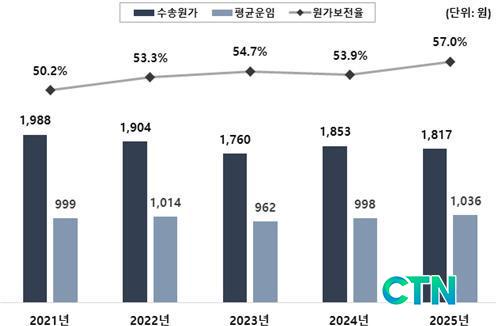
서울교통공사(사장 김태균)는 지난해 지하철 승객 1명을 수송하는 데 평균 1,817원의 비용이 소요됐으나, 실제 벌어들인 평균 운임은 1,036원에 그쳐 승객 1명당 781원의 손실이 발생했다고 밝혔다. 승객이 내는 운임이 수송 원가의 절반 수준인 57%(원가 보전율)에 불과한 실정이다.
지난해 인건비, 감가상각비, 수도광열비 등을 포함해 집계된 승객 1명당 수송원가는 1,817원이다. 호선별로 살펴보면 이용객이 가장 많은 2호선의 수송원가가 1,374원으로 가장 낮았고, 상대적으로 수요가 적은 6호선이 2,343원으로 가장 높았다.
반면 승객 1명당 평균 운임은 1,036원 수준이었다. 2024년 대비 승차 인원이 2,700만 명(1.6%) 증가하고 기본 운임이 150원 인상되었음에도 불구하고, 실제 평균 운임은 전년 대비 38원 소폭 상승하는 데 그쳐 높은 수송원가와의 격차를 좁히기엔 역부족이었다.
공사의 원가 보전율은 2021년 50.2%를 기록한 이후 최근 5년간 줄곧 50%대 박스권에 갇혀 있다.
이 같은 만성 적자의 이면에는 국가 정책에 따른 무임수송 및 버스 환승 할인 등 공익서비스(PSO) 제공이라는 구조적 요인이 자리 잡고 있다.
공사는 지난해 총수익 2조 3,728억 원, 총비용 3조 1,996억 원을 기록하며 8,268억 원의 거대한 당기순손실을 기록했다.
주목할 점은 공사가 전액 부담한 공익서비스 비용이 8,167억 원으로, 당기순손실 규모와 거의 일치한다는 점이다.
공익서비스 손실 중 가장 큰 비중을 차지한 것은 노인·장애인 등을 위한 '무임수송'으로 무려 4,488억 원에 달했다. 이어 버스 환승 할인(2,907억 원), 정기권 등(772억 원) 순이었다.
특히 무임수송 손실은 2020년 2,643억 원에서 5년 새 약 70% 급증했으며, 고령화 추세에 따라 앞으로 그 규모가 걷잡을 수 없이 커질 것으로 전망된다.
현재 서울교통공사의 무임수송 손실액은 전국 6개 도시철도 운영기관 전체 손실액(7,754억 원)의 절반 이상을 차지할 정도로 압도적이다.
그러나 타 지자체 운영기관과 달리 정부나 지자체의 별도 비용 지원 없이 공사가 이 손실을 고스란히 떠안고 있다. 자산 매각, 인건비 절감, 부정승차 단속 등 뼈를 깎는 자구책에도 불구하고 한계에 다다랐다는 지적이 나오는 이유다.
' 설상가상으로 개통 후 50년이 지난 노후 시설물에 대한 안전 투자 비용과 가파르게 오른 전기요금도 큰 부담이다.
공사는 2025년부터 2029년까지 연평균 7천억~9천억 원대의 안전 투자사업비를 지속해서 투입해야 하는 상황이다.
여기에 2022년 이후 7차례 진행된 전기요금 인상 여파로 공사가 부담한 전기료는 2021년 대비 60%(1,005억 원)나 급증했다.
한영희 서울교통공사 기획본부장은 “무임수송은 국가 정책으로 시행되는 보편적 복지 서비스인 만큼, 그에 따른 사회적 비용 역시 정부 차원의 책임 있는 자세가 필요하다”라며, “시민의 이동권 보장과 대중교통의 지속 가능한 운영을 위해 정부의 무임 손실 지원 방안이 조속히 마련되어야 한다”고 강력히 촉구했다.
[영문 번역기사-AI]
Seoul Subway Loses 781 Won Per Passenger… Financial Limits Reached Due to Free Rides and Soaring Electricity Bills
[Seoul/CTN] Reporter Geum-hyun Ga= Seoul Metro, the operator of Seoul Subway Lines 1 to 8, is facing a severe structural financial crisis, losing money on every single passenger it carries.
According to Seoul Metro (CEO Tae-kyun Kim), it cost an average of 1,817 won to transport one passenger last year, while the actual average fare collected was only 1,036 won. This resulted in a deficit of 781 won per passenger. The fare paid by passengers covers only 57% (cost recovery rate) of the actual transport cost, meaning the subway recovers only about half of its operating expenses.
◇ Disparity by Subway Lines: Line 6 Records Highest Transport Cost The total transport cost per passenger, which includes labor costs, depreciation, and utility bills like electricity, stood at 1,817 won last year. By line, Line 2—which handles the highest volume of passengers—had the lowest transport cost at 1,374 won. Conversely, Line 6 recorded the highest cost at 2,343 won per passenger due to lower traffic.
Meanwhile, the average fare per passenger was 1,036 won. Despite a 1.6% increase in ridership (up by 27 million passengers) compared to 2024 and a base fare hike of 150 won, the average fare rose by a mere 38 won. This was far from enough to close the gap with the high transport costs. The corporation's cost recovery rate has remained stagnant in the 50% range for five consecutive years since recording 50.2% in 2021.
◇ Snowballing Public Service Deficit Driven by Free Rides Behind this chronic deficit lies a structural issue: the provision of Public Service Obligations (PSO), such as free rides for the elderly and disabled, and bus transfer discounts mandated by national welfare policies. Last year, Seoul Metro posted a massive net loss of 826.8 billion won, with total revenues at 2.3728 trillion won and total expenses at 3.1996 trillion won. Notably, the cost of public services borne entirely by the corporation reached 816.7 billion won, almost identical to its total net loss.
Free rides accounted for the largest share of the public service losses, costing a whopping 448.8 billion won. This was followed by bus transfer discounts (290.7 billion won) and commuter passes (77.2 billion won). Losses from free rides have surged by approximately 70% over the past five years—up from 264.3 billion won in 2020—and are projected to grow exponentially due to South Korea's rapidly aging population.
Seoul Metro's free ride deficit is the largest among the six urban railway operators nationwide, accounting for more than half of the total national loss of 775.4 billion won. However, unlike other regional operators, Seoul Metro bears the entire financial burden without separate subsidies from the central government. Experts point out that the corporation has reached its financial limit despite painful self-rescue measures, including selling real estate assets, reducing labor costs, and cracking down on fare evasion.
◇ Double Whammy: Aging Infrastructure Reinvestment and Rising Utility Costs To make matters worse, the corporation faces a double whammy of mandatory safety reinvestments for aging facilities—some operating for over 50 years—and skyrocketing electricity rates. Seoul Metro must continuously invest between 700 billion and 900 billion won annually from 2025 to 2029 for safety upgrades. Furthermore, due to seven consecutive electricity rate hikes since April 2022, the corporation's electricity bill has jumped by 60% (100.5 billion won) compared to 2021.
"Since free rides are a public interest service implemented under national policy, the central government needs to take a responsible stance on the resulting social costs," said Young-hee Han, Head of the Planning & Coordination Headquarters at Seoul Metro. She strongly urged, "To guarantee citizens' right to mobility and ensure the sustainable operation of public transportation, a government subsidy plan for free ride losses must be established immediately."
#스포츠 #CTN #서울교통공사 #지하철적자 #무임수송 #수송원가 #당기순손실 #지하철요금 #가금현기자 #대중교통정부지원
 |
가금현 기자 ggh7000@hanmail.net
가금현 기자 입니다.
긍정적인 사고로 의리를 지키며 살고싶다.
술은 웃음소리가 밖에까지 들리도록 마셔라!
내가 그자리에 있다고
CTN·교육타임즈·충청탑뉴스·CTN방송 발행인
|