2026.06.11(목) 10:50
 교육타임즈 지면신문









|
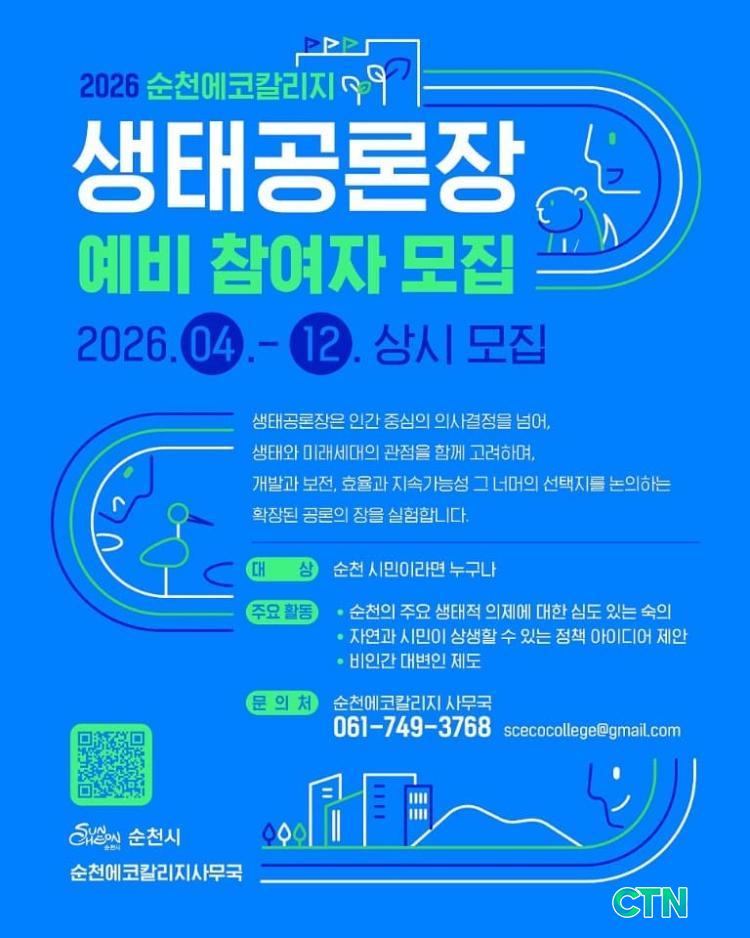
공론장에서 논의될 구체적인 의제는 전용 온라인 플랫폼을 통해 순천시민이라면 누구나 자유롭게 제안할 수 있다. 플랫폼에 등록된 다양한 일상 속 환경 현안이나 지역 사회 현안들은 사무국의 사전 검토와 분류 과정을 거쳐 향후 열릴 공론장의 정식 토론 주제로 최종 반영될 예정이다. 생태공론장 참여를 희망하는 시민은 배포된 홍보물의 QR코드를 스캔하거나 지정된 온라인 구글 폼 서식을 통해 신청하면 된다. 순천에코칼리지는 신청자들을 대상으로 예비 참여자 명부를 작성한 뒤, 공론장이 개최될 때마다 무작위 추첨 방식을 적용해 최종 참가자를 공정하게 선정할 방침이다. 위원회는 다가오는 7월 초 예비참여자들을 대상으로 전반적인 운영 방향을 공유하는 오리엔테이션을 개최하고, 뒤이어 제1회차 생태공론장을 공식 가동하며 본격적인 숙의 일정에 돌입한다.
순천에코칼리지 관계자는 "생태공론장은 시민이 순천의 생태적 의제를 직접 발굴하고 숙의하는 실험적 시도로, 순천시가 생태문명과 숙의민주주의 선도 도시로 나아가는 중요한 과정이 될 것"이라고 강조했다. 이처럼 시민들이 직접 정책 수립의 주체로 나서는 민관 협치 모델은 행정의 투명성을 높이고 주민 자치를 실현한다는 점에서 긍정적인 평가를 받는다. 특히 '비인간 대변인 제도'와 같은 참신한 시도는 기후위기 시대에 걸맞은 선진적 환경 행정 사례로 꼽힌다.
다만 이러한 시민 참여형 공론장이 실질적인 제도 개선으로 이어지기 위해서는 온라인 플랫폼 제안의 실제 정책 반영률을 담보하고, 추첨 과정에서 특정 연령대나 계층에 편중되지 않도록 인구통계학적 비례성을 정교하게 정립해야 한다는 지적이 나온다. 무작위 추첨에만 의존할 경우 환경 문제에 관심이 높은 특정 계층만 반복해서 선정되거나 대다수 일반 시민들의 참여율이 저조해질 수 있어, 공론장 도출 결과의 대표성을 확보하는 정밀한 스크리닝 시스템 구축이 필요해보인다.
[영문번역 기사-AI활용]
Suncheon Eco-College announced that it is recruiting preliminary participants year-round for the 'Ecological Forum,' a citizen-participatory deliberative program where residents directly discover ecological agendas and propose policy ideas. The Ecological Forum is an open communication body designed to reinterpreting and resolving various local pending issues such as the environment, transportation, housing, and education from an ecological perspective. In particular, this forum introduces a newly devised 'Non-Human Spokesperson System,' where citizens take on the role of directly representing nature and the ecosystem, moving away from conventional debate methods focused solely on human interests.
Specific agendas to be discussed at the forum can be freely proposed by any Suncheon citizen through a dedicated online platform. Various daily environmental and community issues registered on the platform will be reflected as official discussion topics for future forums after review and classification by the secretariat. Citizens wishing to participate can apply by scanning the QR code on promotional materials or using the designated online Google Form. Suncheon Eco-College plans to compile a roster of preliminary applicants and fairly select final participants through a random lottery system whenever a forum is held. The organization will hold an orientation session for the preliminary participants in early July to share the overall operational direction, followed by the official launch of the first Ecological Forum to begin the deliberation schedule.
An official from Suncheon Eco-College emphasized, "The Ecological Forum is an experimental attempt where citizens directly discover and deliberate on Suncheon's ecological agendas, and it will serve as an important process for Suncheon City to advance into a leading city for ecological civilization and deliberative democracy." This public-private governance model is evaluated positively for enhancing administrative transparency and realizing resident autonomy. In particular, novel attempts such as the 'Non-Human Spokesperson System' are regarded as advanced environmental administration cases suitable for the era of climate crisis.
However, experts point out that for this citizen-participatory forum to lead to substantial institutional improvement, authorities must guarantee the actual policy reflection rate of online proposals and sophisticatedly establish demographic proportionality to prevent bias toward specific age groups or social classes during the lottery process. Relying solely on random drawings may result in the repeated selection of specific groups with high interest in environmental issues or low participation from the general public, making a precise screening system to secure the representativeness of the forum's outcomes a prerequisite.
 |
하성매 기자 jyh7583@naver.com
하성매 기자 입니다.
|